What is EasePilot?
EasePilot is a private on-site AI admin operator for owner-led healthcare practices. It runs on a local appliance, works defined back-office workflows, prepares evidence-rich approval packets, and records an audit trail for every recommendation and action.
Is EasePilot HIPAA certified?
No. There is no official HIPAA certification that makes a vendor magically compliant. EasePilot is built around a HIPAA-ready AI architecture: BAA available before PHI access, PHI local by default, least-privilege workflow access, approval gates, and audit logs. Your practice still owns its HIPAA program.
Does PHI leave the practice?
The default architecture keeps PHI processing and storage on the on-site appliance. If a future workflow benefits from cloud reasoning, it must be disclosed, logged, and limited to de-identified or approved content. The founding install is designed to avoid routine PHI cloud transfer.
Does this replace an EHR, PMS, RCM vendor, or phone system?
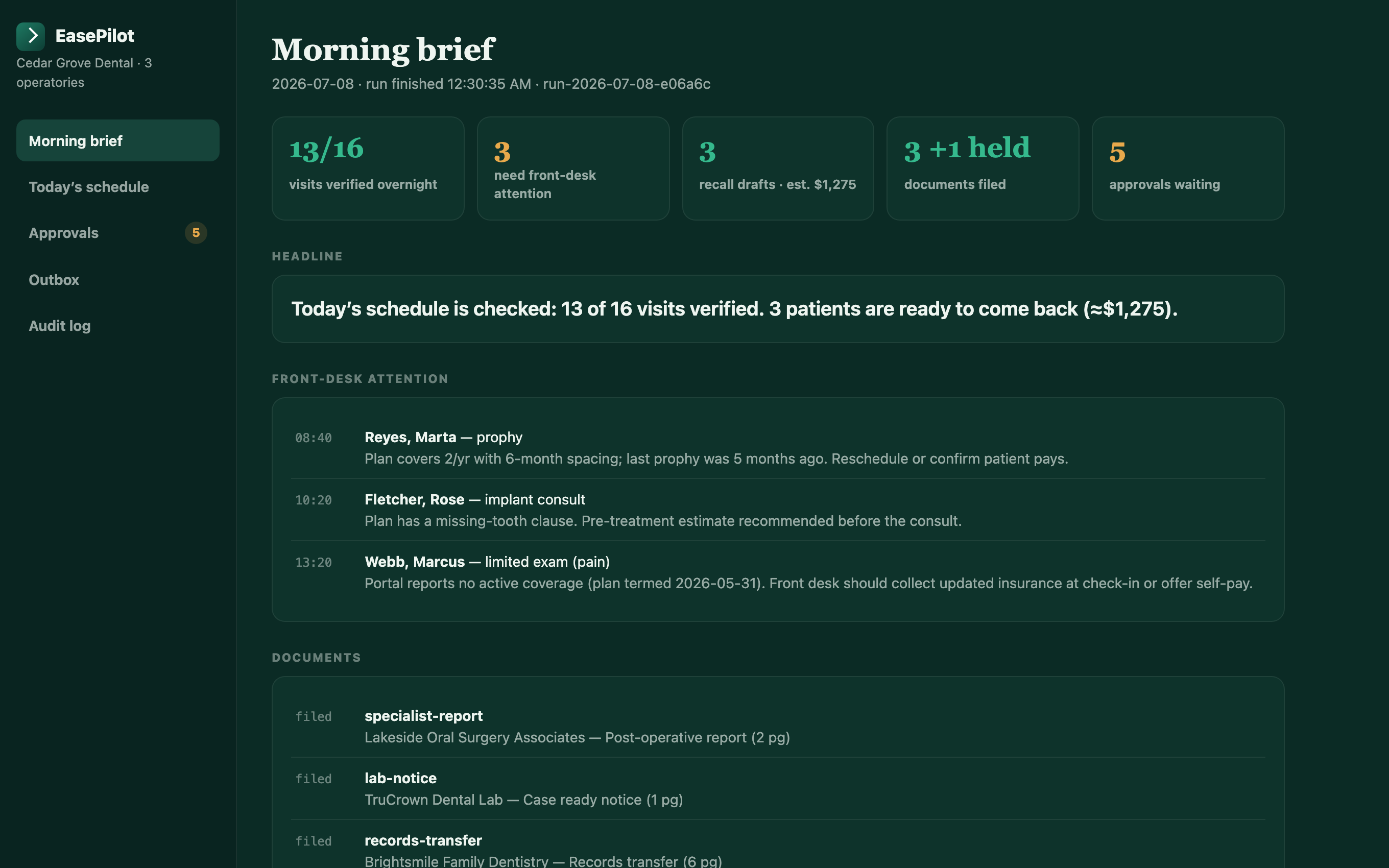
No. EasePilot works between the systems your staff already uses. It is not an EHR replacement, clinical decision tool, billing company, or AI receptionist. The wedge is back-office admin loops: eligibility checks, intake chasing, recall reactivation, fax triage, prior-auth prep, and schedule-gap backfill.
Can it do dental insurance verification?
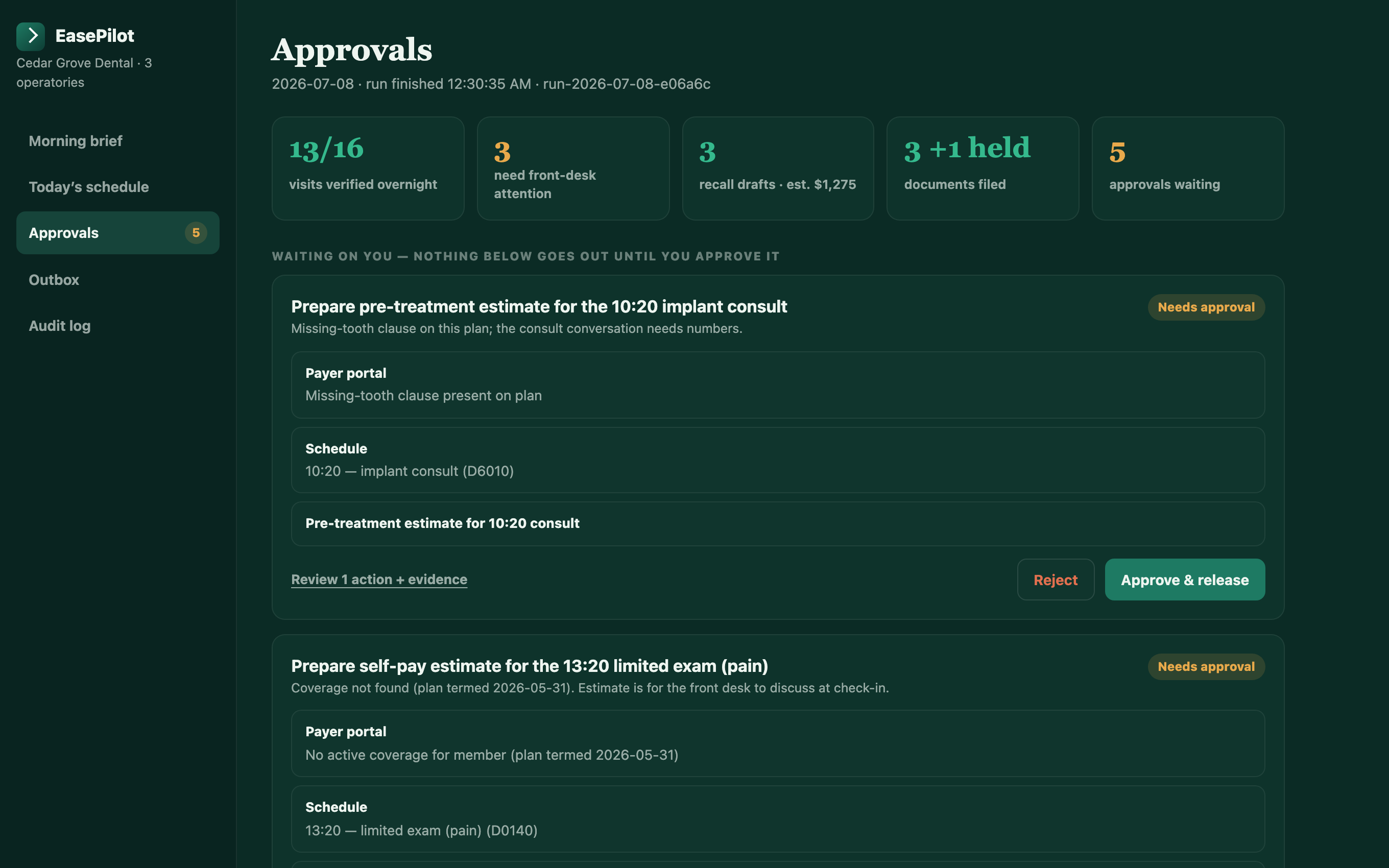
Yes, dental insurance verification is one of the clearest first workflows. EasePilot can run a schedule against payer portals, collect evidence, summarize benefits, and flag exceptions. Patient communication, estimates, and anything financially sensitive remain approval-gated.
What actions can run automatically?
Only low-risk actions defined in the written workflow policy can run automatically after shadow review. Patient messages, payment or refund activity, clinical judgment, chart changes, record release, and anything ambiguous ask for human approval or are blocked.
What if it makes a mistake?
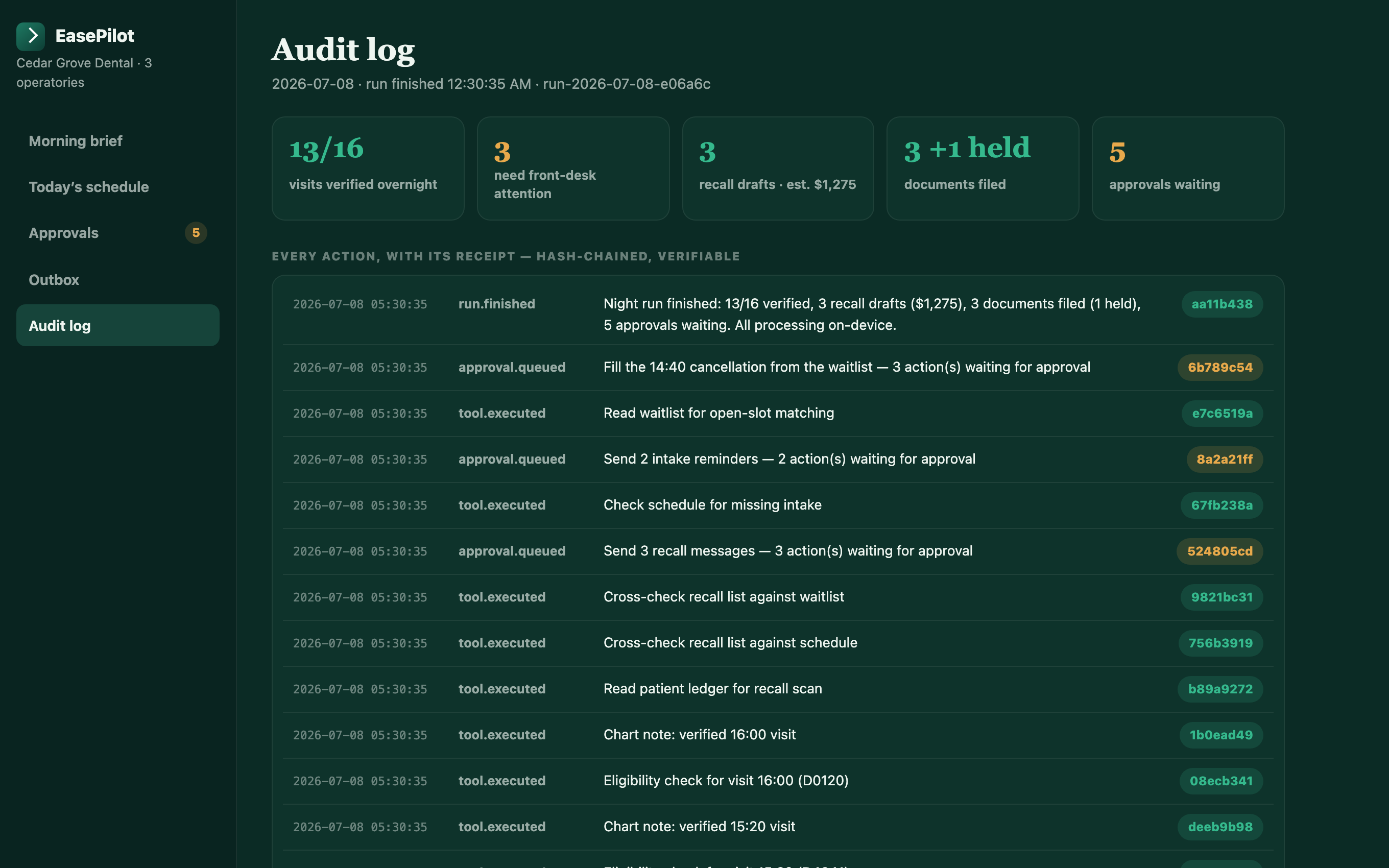
The first phase is shadow mode. EasePilot prepares work and shows evidence before your team approves anything, and rejecting is a first-class action: rejected work never runs, and the rejection itself is recorded. Every event, decision, approval, and action lands in a hash-chained audit log that can be re-verified with one command.
How long does implementation take?
A focused install is designed for 30 days: fit call, BAA and workflow policy, appliance install, shadow week, and measured launch. If the workflow cannot be measured in that window, it is not a good founding fit.